How Accurate Are Fitness Trackers for Calories Burned? (And What to Do Instead)
A hard workout says 612 calories burned on your watch. The heart rate is probably right — the calorie number almost certainly isn't. Here's why wearables miss by 20-90%, and what to track instead.

Fact-checked against peer-reviewed sources. Last updated: September 12, 2026.
You finish a hard 45 minutes at the gym, glance at your wrist, and it says 612 calories burned. The obvious next thought is that you've earned a 600 calorie meal.
That's the moment where a lot of weight loss plans quietly go sideways.
The heart rate on that screen is probably close to correct. The calorie figure sitting right next to it is a different story. Research on consumer wearables has repeatedly found energy expenditure errors ranging from roughly 20% on the good end to over 90% on the bad end, depending on the device and the activity.
A Stanford Medicine team tested seven popular wrist wearables and found heart rate accuracy was strong across the board, with error typically under 5%. Energy expenditure was a different result entirely. Not one device came close to what you'd call acceptable, and the spread between best and worst was enormous.
So the hardware isn't the problem. The math layered on top of it is.
How your watch actually arrives at a calorie number
Your tracker doesn't measure calories. There is no sensor on your wrist capable of detecting energy expenditure directly. The lab method for that involves either a metabolic cart measuring oxygen consumption and carbon dioxide production, or doubly labeled water over a period of days.
What your device does instead is stack estimates on top of estimates.
Step one: your baseline. The watch takes your height, weight, age, and sex, then runs a standard predictive formula such as Mifflin-St Jeor or Harris-Benedict to guess your basal metabolic rate. That formula alone typically carries a 10% error for any given individual, and considerably more if your body composition sits outside average.
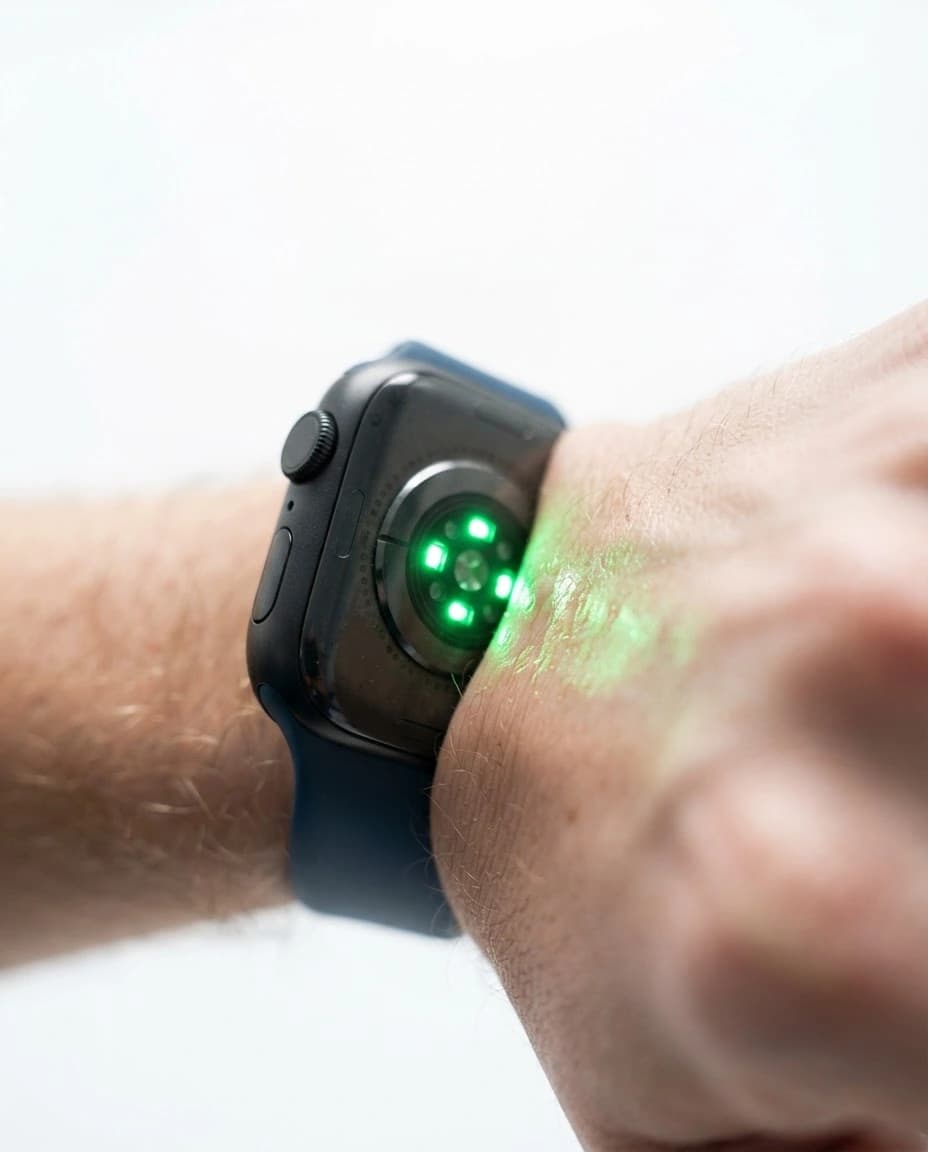
Step two: your movement. An accelerometer reads wrist motion. An optical sensor shines green light into your skin and reads changes in blood flow to infer pulse.
Step three: the translation. A proprietary algorithm converts heart rate and motion into an assumed oxygen consumption rate, then into calories.
Every one of those steps introduces error, and the errors compound rather than cancel out.
Why heart rate is a poor proxy for calorie burn
Heart rate correlates with energy expenditure. It doesn't equal it.
Your pulse rises for plenty of reasons that have nothing to do with burning fuel:
- Caffeine, particularly a pre-workout taken 30 minutes before training
- Heat and humidity, which push heart rate up as the body works to cool itself
- Dehydration, which reduces blood volume and forces more beats per minute
- Stress, anxiety, poor sleep, or being mildly ill
- Simply being deconditioned, which raises heart rate at any given workload
A stressed, caffeinated, dehydrated person walking on a treadmill will log a higher heart rate and therefore a higher calorie estimate than a calm, well hydrated person doing identical work. The actual energy cost of that walk is close to identical.
The algorithms are closed and generalized
Manufacturers don't publish how their calorie models work. The equations are built from population averages, which means the device is essentially guessing that you respond the way a typical study participant did.
That's fine if you sit near the middle of the distribution. If your resting metabolic rate runs 15% above or below prediction, which is common, the error carries into every workout the device logs for the rest of the year.
Where accuracy fails worst
Not all activities are estimated equally badly.
| Activity type | Rough error range | Why |
|---|---|---|
| Walking, jogging, steady running | 20% to 30% | Predictable cadence, steady heart rate, well studied movement patterns |
| Cycling | 25% to 40% | Wrist motion barely reflects leg work; power output is invisible to the watch |
| Resistance training | 50%+ | Sets are short, heart rate lags the effort, the wrist is often stationary under load |
| HIIT and circuit work | 50%+ | Heart rate stays elevated between efforts, so the device keeps billing you for work you aren't doing |
| Yoga, stretching, mobility | Highly variable | Low motion, low heart rate, little for the algorithm to work with |
Weightlifting is the worst case by a wide margin. The oxygen cost of a heavy set is genuinely low compared to how it feels, but your heart rate spikes anyway. The watch reads the spike and bills you accordingly.
There's a second gap worth naming. NIH supported research has found that standard motion based algorithms perform notably worse for people with higher BMIs. Gait mechanics differ, resting metabolic rate varies more from prediction, and the reference data these models were trained on skewed toward leaner participants. The people most likely to be using a tracker for weight loss are often the ones getting the least accurate numbers.
Long-term burn doesn't add up the way the app implies
Your app presents exercise calories as though they stack cleanly on top of your baseline. Evidence on total daily energy expenditure suggests the body doesn't behave that way over weeks and months.
As activity rises and stays high, the body tends to economize elsewhere, reducing energy spent on resting processes and unconscious movement. Some of the calories your watch adds during a workout get silently subtracted from the rest of your day. The app has no way to see that happening.
The "eating back calories" trap
Here's how the error turns into a stalled scale.
Say your true burn for a session is 400 calories. Your watch reports 540, a 35% overestimate that is entirely normal for resistance work.
You eat those 540 back. Your planned 500 calorie daily deficit is now 360. Repeat that five days a week and you've erased close to a full day's deficit every week without breaking a single rule you set for yourself.
There's a second problem layered underneath. Many apps sync total calories rather than active calories, which means the resting burn already built into your daily target gets counted a second time. A 500 calorie workout entry can contain 120 calories of basal metabolism you were already budgeting for.
| Setting | What it means | Safe to eat back? |
|---|---|---|
| Active calories | Only the burn above resting baseline | Partially, at most |
| Total calories | Active burn plus BMR for the session | No, this double counts |
A practical rule: if you're going to eat back exercise calories at all, cap it at 50% of what the device claims, and only ever from the active figure. That single adjustment absorbs most of the typical overestimate.
What to track instead
1. Set a static baseline. Calculate your BMR with a validated formula and build your intake target from that fixed number. A stable starting point you adjust deliberately beats a number that moves every day based on whether you had coffee.
2. Use the watch for relative metrics. Wearables are genuinely good at the things they measure rather than model. Resting heart rate trends, heart rate variability, sleep duration, step count trends, and training consistency are all useful. Treat the calorie display as an intensity gauge, not a food allowance.
3. Let the scale settle the argument. Weigh yourself daily under the same conditions, then compare weekly averages over two to three weeks. If the average isn't moving at the rate you planned, adjust intake by 100 to 200 calories. Real world data beats any algorithm's guess about your metabolism.
Frequently Asked Questions
Which fitness tracker is most accurate for calories?
None of them meet clinical accuracy standards for energy expenditure. Some perform better than others in testing, but the gap between a good device and a bad one is still far larger than the margin most diets can absorb. For heart rate, chest strap monitors outperform every wrist device.
Why do my Apple Watch and Garmin show different calories for the same workout?
Different proprietary algorithms, different BMR assumptions, and different choices about how to weight heart rate against motion. Neither is a measurement, so there's no reason for them to agree.
Should I unlink exercise calories from my diet app?
For most people, yes. Turning off the sync keeps your daily target fixed and removes the temptation to spend calories you may not have burned. Log the workout for training records, not for food budgeting.
Does a chest strap make the calorie number accurate?
It makes the heart rate input more accurate, which helps at the margins. The translation from heart rate to calories is still an estimate built on population averages.
The bottom line
Your smartwatch is a good training tool and a poor accounting tool. Read the calorie number as a rough signal of how hard a session was relative to your other sessions, and nothing more than that.
Build your plan on a calculated baseline and verify it against the scale.
Start with your baseline numbers in the Mifflin-St Jeor BMR Calculator, then see how activity factors into your daily target in our guide to BMR vs. TDEE.
Sources
- Shcherbina A, et al. "Accuracy in Wrist-Worn, Sensor-Based Measurements of Heart Rate and Energy Expenditure in a Diverse Cohort." Journal of Personalized Medicine, 2017 (Stanford University). PubMed
- Mayo Clinic, 2024. Comparison of wearable device energy expenditure estimates against doubly labeled water. PubMed search

Written by
Rahul Kumar
Independent developer and writer. I build calorie and metabolism calculators and explain the research behind them. I’m not a doctor or dietitian; every article is based on published studies, linked in the Sources section below.
Related reading
All articles Fundamentals
BMR Chart by Age and Weight for Men and Women
Find your BMR in seconds from a chart. Two tables for women and men by age and weight, a simple height adjustment, and what the latest research says about metabolism and age.
 Fundamentals
How Big Should Your Calorie Deficit Be?
Too big a deficit stalls progress through fatigue and muscle loss. Too small feels invisible. Here's how to size yours based on real research, not guesswork.
 Fundamentals
Macro Split by Goal: How to Set Protein, Carbs, and Fat for Cut, Maintain, or Bulk
Total calories decide the scale. But your protein, carb, and fat split shapes hunger, muscle retention, and training performance. Here's how to set it by goal.