BMR vs. TDEE Explained: What's the Difference and Which One Should You Use?
BMR is the calories you burn at complete rest; TDEE is your BMR plus everything else you do in a day. Here's how they differ, how to go from one to the other, and the #1 mistake people make: double-counting exercise calories.
Fact-checked against peer-reviewed sources. Last updated: August 13, 2026.
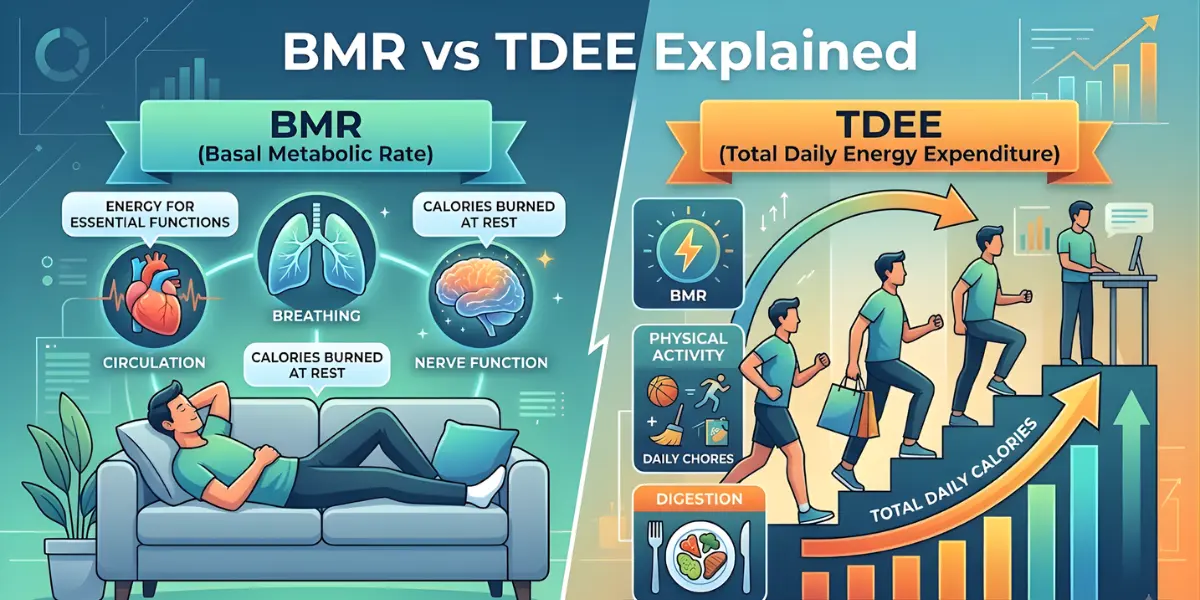
Quick answer: BMR (Basal Metabolic Rate) is the number of calories your body burns at complete rest just to stay alive. TDEE (Total Daily Energy Expenditure) is your BMR plus every other calorie you burn in a day — walking, working, exercising, and digesting food. When you're setting a calorie target for weight loss, weight gain, or maintenance, TDEE is the number you should use, not BMR.
If that still feels a little confusing, you're not alone — mixing up BMR and TDEE is one of the most common reasons people set the wrong calorie target and then wonder why the scale won't move. This guide breaks down exactly what each number means, how they're calculated, and clears up the specific confusion that trips most people up: double-counting exercise calories.
BMR vs. RMR vs. TDEE: The Full Picture
Three acronyms get thrown around interchangeably, but they measure different things:
| Term | Full Name | What It Measures | Where It Ranks |
|---|---|---|---|
| BMR | Basal Metabolic Rate | Calories burned at complete, lab-strict rest (fasted 12+ hours, fully still, thermally neutral room) | Lowest number |
| RMR | Resting Metabolic Rate | Calories burned at rest under everyday (less strict) conditions — includes minor movement like digestion | ~5–10% higher than BMR |
| TDEE | Total Daily Energy Expenditure | Total calories burned across a full day, including all activity | Highest number — always bigger than BMR and RMR |
In everyday use, most online calculators — including formula-based ones — actually estimate RMR and label it "BMR." The distinction rarely changes your practical decisions, but it's worth knowing the terms aren't identical.
How BMR Is Calculated: The Mifflin-St Jeor Formula
The most widely recommended formula for estimating BMR is the Mifflin-St Jeor equation, developed in 1990 and still considered the gold standard for healthy adults today.
For men:
BMR = (10 × weight in kg) + (6.25 × height in cm) − (5 × age in years) + 5
For women:
BMR = (10 × weight in kg) + (6.25 × height in cm) − (5 × age in years) − 161
A widely-cited systematic review comparing predictive equations found Mifflin-St Jeor was more likely than older formulas, including Harris-Benedict, to predict resting energy expenditure within 10% of lab-measured values — which is why it's the formula most dietitians default to.
Want the full breakdown, including formula history and a step-by-step worked example? Read our complete guide to the Mifflin-St Jeor equation.
Worked Example: From BMR to TDEE
Let's walk through the full chain using a real profile.
Profile: 35-year-old man, 82 kg, 178 cm, moderately active (exercises 3–5 days a week).
Step 1 — Calculate BMR:
BMR = (10 × 82) + (6.25 × 178) − (5 × 35) + 5
BMR = 820 + 1,112.5 − 175 + 5
BMR = 1,762.5 calories/day
Step 2 — Apply an activity multiplier to get TDEE:
TDEE = BMR × activity multiplier
TDEE = 1,762.5 × 1.55 (moderately active)
TDEE = 2,731 calories/day
So this person's body needs about 1,763 calories just to survive at complete rest — but his actual daily calorie burn, once you factor in his job, workouts, and daily movement, is closer to 2,731 calories. If his goal is fat loss, he should be setting his calorie target relative to that 2,731 figure — not the 1,763 BMR number.
The 4 Components That Make Up Your TDEE
TDEE isn't one single measurement — it's the sum of four separate energy costs:
| Component | Full Name | % of TDEE | What It Covers |
|---|---|---|---|
| BMR | Basal Metabolic Rate | 60–75% | Baseline survival functions |
| NEAT | Non-Exercise Activity Thermogenesis | 15–30% | Walking, fidgeting, standing, chores — movement outside formal workouts |
| TEF | Thermic Effect of Food | ~10% | Calories burned digesting and processing food (protein burns the most) |
| EAT | Exercise Activity Thermogenesis | 5–15% | Calories burned during intentional workouts |
Notice that NEAT is often a bigger chunk of your daily burn than structured exercise. This is exactly why two people with identical stats and the same gym routine can have very different TDEEs — their daily movement outside the gym (job type, fidgeting, walking habits) can vary enormously.
Should You Add Exercise Calories on Top of Your TDEE? (The #1 Source of Confusion)
This is the question that trips up more people than any other part of the BMR/TDEE conversation — and it's rarely addressed clearly.
Here's the core issue: your activity multiplier already accounts for a general level of exercise. If you calculated your TDEE using the "moderately active" multiplier (1.55) because you work out 3–5 days a week, your workouts are already baked into that number.
The mistake: Adding your fitness tracker's "active calories burned" (from your Apple Watch, Fitbit, or gym machine) on top of that TDEE figure — effectively counting the same exercise twice.
How to avoid double-counting:
- If you use a fixed activity multiplier (Sedentary, Lightly Active, Moderately Active, etc. — the standard 1.2 to 1.9 method), your TDEE already includes a general estimate of your workouts. Don't add your fitness tracker's exercise calories on top of this number.
- If you use the daily logging method (see next section), where you calculate BMR only and then log each day's actual activity separately, it's appropriate to add your tracked exercise calories to your BMR each day — since you haven't already estimated activity with a multiplier.
The confusion almost always comes from mixing both methods at once — using a "Very Active" multiplier to set TDEE and then also adding a smartwatch's calorie count for the same workout. Pick one method and stick with it consistently.
Static Multiplier vs. Daily Logging: Which Method Should You Use?
There are two legitimate ways to estimate your daily calorie needs, and mixing them is where most people go wrong.
| Method | How It Works | Best For | Watch Out For |
|---|---|---|---|
| Static Multiplier | Calculate BMR once, multiply by a fixed activity factor (1.2–1.9) to get one TDEE number you use every day | People with fairly consistent weekly routines | Overestimating your activity level — most people round up |
| Daily Logging | Calculate BMR only, then add your actual tracked activity/exercise calories each day from a fitness tracker or app | People with highly variable schedules (some days sedentary, some days very active) | Fitness tracker calorie estimates can themselves be inaccurate by 20–30% |
Neither method is more "correct" than the other — they're just different ways of estimating the same thing. The key is not combining them, since that's what leads to the double-counting problem above.
Common Myths About BMR and TDEE
Myth: Eating below your BMR permanently damages your metabolism. Reality: Short-term dieting below BMR doesn't cause permanent metabolic damage, but sustained, extreme restriction can lead to adaptive thermogenesis — a temporary slowdown in metabolic rate as the body tries to conserve energy. This is a real, studied phenomenon, but it's typically reversible with adequate refeeding, not permanent.
Myth: "Starvation mode" means you'll stop losing weight entirely if you eat too little. Reality: Severe calorie restriction can slow metabolic rate somewhat, but it does not stop fat loss altogether. The bigger practical problems with eating too far below BMR are muscle loss, fatigue, and unsustainability — not a complete halt in progress.
Myth: A higher TDEE number always means a "faster metabolism." Reality: TDEE is heavily influenced by activity level, not just metabolic rate. Someone with an average BMR but a physically demanding job can have a higher TDEE than someone with a genuinely faster BMR but a sedentary lifestyle.
Myth: You should always eat at your BMR to lose weight fastest. Reality: Eating at BMR ignores the energy your body needs for daily activity, creating a deficit that's often far too aggressive. This typically backfires — leading to muscle loss, low energy, and diet burnout rather than better results.
Which Number Should You Actually Use?
| Goal | Use This Number | Approach |
|---|---|---|
| Weight Loss | TDEE | Eat 300–500 calories below TDEE for a sustainable ~0.5–1 lb/week loss |
| Muscle Gain | TDEE | Eat 200–500 calories above TDEE, paired with resistance training |
| Maintenance | TDEE | Eat at your TDEE to hold weight steady |
| Safety Check Only | BMR | Never eat below your BMR for extended periods — treat it as a floor, not a target |
Frequently Asked Questions
Is TDEE always higher than BMR?
Yes. TDEE always equals or exceeds BMR, since it includes BMR plus activity, digestion, and exercise — it's never lower.
Should I subtract exercise calories from my TDEE if I didn't work out that day?
No, if you're using a fixed activity multiplier — it already reflects your average week, not a single day. Only subtract or add calories daily if you're using the daily-logging method instead.
Why does my fitness tracker's calorie estimate not match my TDEE calculator?
Fitness trackers can carry a 20–30% margin of error from heart-rate and motion sensors. Treat both numbers as estimates and trust your real-world weight trend over 2–3 weeks instead.
Can two people with the same BMR have different TDEEs?
Yes. TDEE depends heavily on activity level and daily movement (NEAT), so two people with identical BMRs can have TDEEs that differ by several hundred calories based on lifestyle alone.
How often should I recalculate my TDEE?
Recalculate whenever your weight shifts by more than a few kilograms/pounds, or roughly every 4–6 weeks if you're actively losing or gaining weight.
Sources
- Mifflin MD, St Jeor ST, Hill LA, et al. "A New Predictive Equation for Resting Energy Expenditure in Healthy Individuals." American Journal of Clinical Nutrition, 1990. PubMed
- Frankenfield D, Roth-Yousey L, Compher C. "Comparison of Predictive Equations for Resting Metabolic Rate in Healthy Nonobese and Obese Adults: A Systematic Review." Journal of the American Dietetic Association, 2005. PubMed
- Academy of Nutrition and Dietetics. Guidance on estimating energy needs in healthy adults. eatright.org

Written by
Rahul Kumar
Independent developer and writer. I build calorie and metabolism calculators and explain the research behind them. I’m not a doctor or dietitian; every article is based on published studies, linked in the Sources section below.
Related reading
All articles Fundamentals
How Big Should Your Calorie Deficit Be?
Too big a deficit stalls progress through fatigue and muscle loss. Too small feels invisible. Here's how to size yours based on real research, not guesswork.
 Fundamentals
Macro Split by Goal: How to Set Protein, Carbs, and Fat for Cut, Maintain, or Bulk
Total calories decide the scale. But your protein, carb, and fat split shapes hunger, muscle retention, and training performance. Here's how to set it by goal.
FundamentalsHow Much Protein Do You Need? The Research
The RDA (0.8g/kg) is a deficiency floor, not a target. Here's what ISSN's position stand and dose-response meta-analyses actually say about protein and muscle.