Know your body's metabolic blueprint.
A free calorie estimator built on the widely-used Mifflin-St Jeor equation for healthy adults. Your BMR, maintenance and weight targets — in one tap.
Biometric Input
Mifflin-St Jeor equation
Awaiting your metrics
Enter your details and hit Calculate to reveal your biometric summary.
More calculators from Mifflin St Jeor
TDEE Calculator
Find your Total Daily Energy Expenditure — BMR plus activity — for weight loss, maintenance, or muscle gain.
Body Fat % Calculator
Estimate your body fat percentage from a tape measure using the US Navy circumference method.
Calorie Deficit Calculator
Get a safe, sustainable daily calorie target for weight loss or gain based on your TDEE.
Macro Calculator
Split your daily calories into protein, carbs, and fat grams based on your goal.
Protein Calculator
Get your daily protein target in grams, based on your weight and goal.
Ideal Body Weight Calculator
Compare Devine, Robinson, Miller, and Hamwi formulas side by side from your height.
Lean Body Mass Calculator
Get your lean mass, fat mass, and Katch-McArdle BMR from weight and body fat %.
What Is BMR, and Why Does It Matter?
Your basal metabolic rate (BMR) is the number of calories your body burns each day just to stay alive, before you take a single step. It covers your heart beating, your lungs breathing, and your cells repairing themselves around the clock.
BMR typically makes up 60 to 75% of the calories you burn in a day, making it the single biggest piece of your energy budget. Knowing it gives you a real starting point for weight loss, muscle gain, or maintaining your current weight.
The Formula This Calculator Uses
This tool runs the Mifflin-St Jeor equation, the formula most dietitians recommend for healthy adults:
| Formula | |
|---|---|
| Men | (10 x weight in kg) + (6.25 x height in cm) - (5 x age) + 5 |
| Women | (10 x weight in kg) + (6.25 x height in cm) - (5 x age) - 161 |
Once you have your BMR, multiplying it by an activity level gives you your Total Daily Energy Expenditure (TDEE), the number that actually reflects how many calories you burn in a full day.
Where to Go From Here
Want the full breakdown, including how BMR differs from RMR and REE, a worked example, and what actually affects your number? Read our complete guide to BMR.
If you're deciding whether to use BMR or TDEE for your calorie target, see BMR vs. TDEE explained. For the formula's full history and how accurate it is, read what the Mifflin-St Jeor equation actually is.
Related articles
 Fundamentals
How Big Should Your Calorie Deficit Be?
Too big a deficit stalls progress through fatigue and muscle loss. Too small feels invisible. Here's how to size yours based on real research, not guesswork.
 Fundamentals
Macro Split by Goal: How to Set Protein, Carbs, and Fat for Cut, Maintain, or Bulk
Total calories decide the scale. But your protein, carb, and fat split shapes hunger, muscle retention, and training performance. Here's how to set it by goal.
FundamentalsHow Much Protein Do You Need? The Research
The RDA (0.8g/kg) is a deficiency floor, not a target. Here's what ISSN's position stand and dose-response meta-analyses actually say about protein and muscle.
FundamentalsIdeal Body Weight Formulas: History Explained
IBW formulas weren't built to tell you your best weight. They were built for drug dosing in the 1960s-80s. Here's why that origin matters for how you use them today.
FundamentalsLean Body Mass: Why It Beats Scale Weight
Two people can lose the same 5kg with very different outcomes underneath. Here's why tracking lean body mass, not just scale weight, shows what's really happening.
 Fundamentals
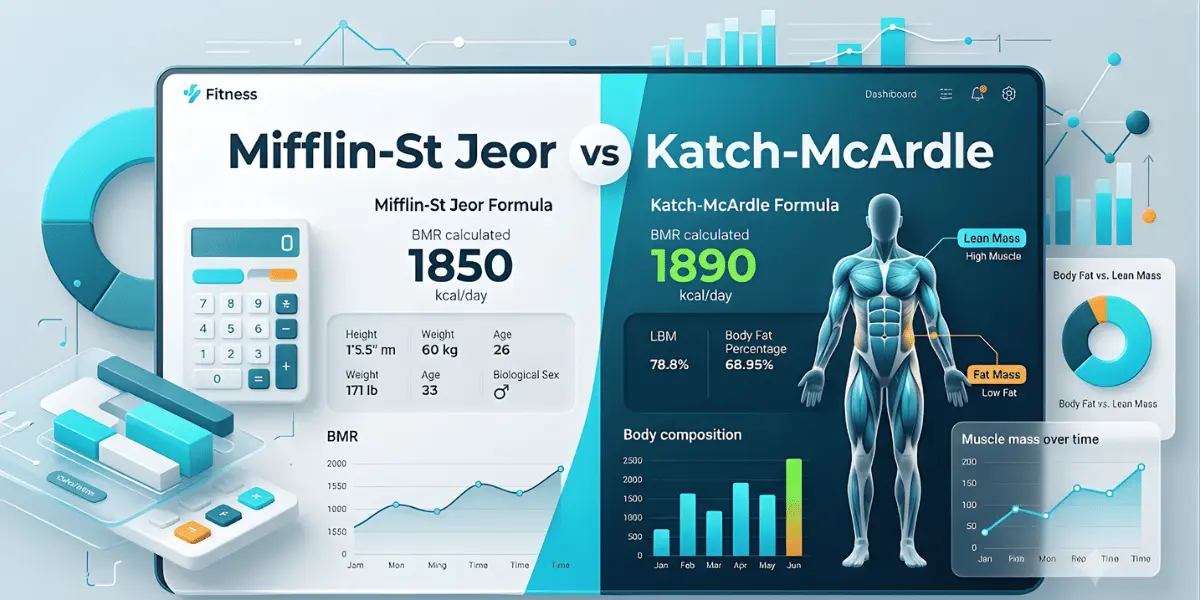
Mifflin-St Jeor vs. Katch-McArdle: Which BMR Formula Is Actually Right for You?
Most weight loss plateaus trace back to the wrong baseline number. See how Mifflin-St Jeor and Katch-McArdle compare by body type, plus a real worked example of how a bad body fat reading breaks a deficit.