Mifflin St Jeor Equation Explained (With Examples)
The Mifflin-St Jeor equation is a scientific formula that calculates your Basal Metabolic Rate (BMR). It uses your age, weight, height, and gender to determine how many calories your body burns at rest. This equation is more accurate than older formulas and is widely used by nutritionists and fitness professionals.
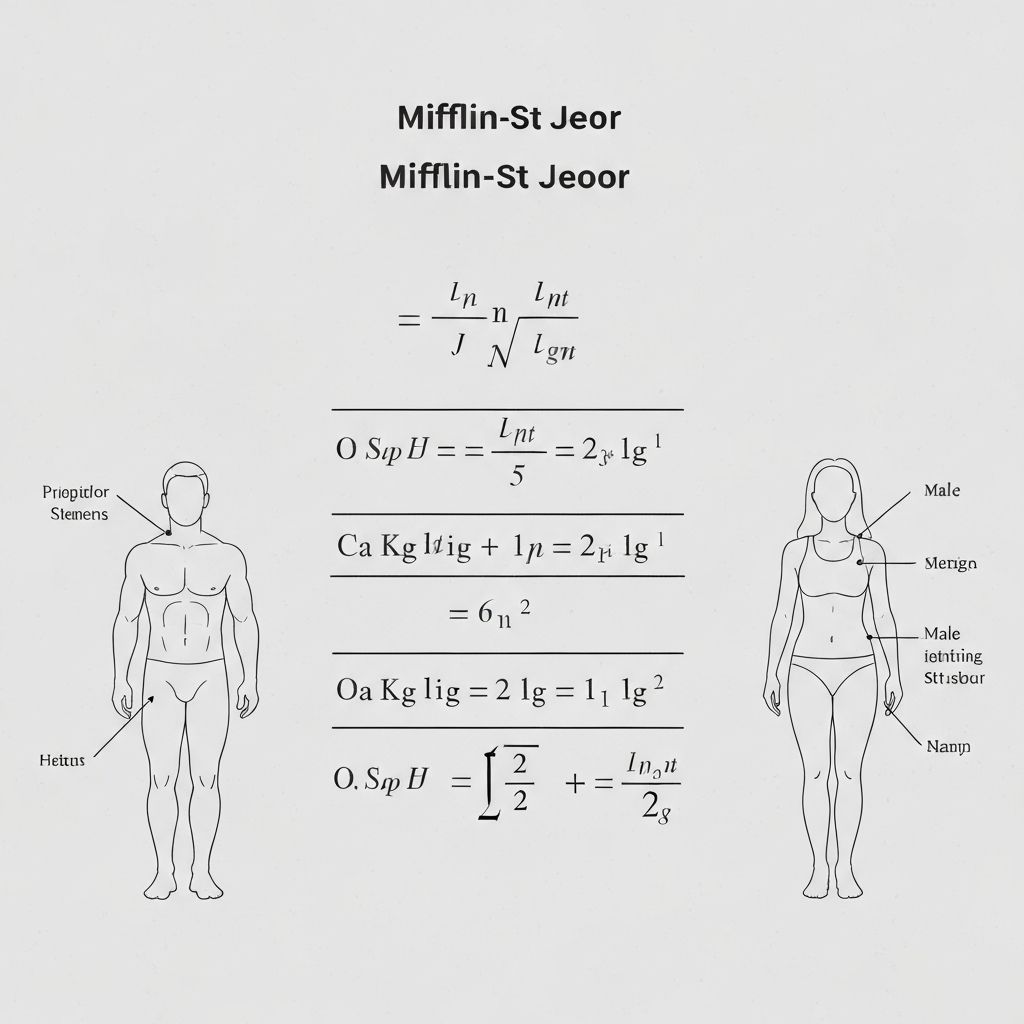
Have you ever wondered how many calories your body burns just sitting around? That number is called your Basal Metabolic Rate, or BMR.
Scientists created the Mifflin-St Jeor equation to help calculate this exact number. This formula is like a special math trick that figures out your metabolism using simple information about your body.
In this guide, we'll break down the Mifflin-St Jeor equation into easy steps, show you real examples, and explain why it works so well. By the end, you'll understand exactly how your BMR is calculated!
What is the Mifflin St Jeor Equation?
The Mifflin-St Jeor equation is a formula that scientists created in 1990 to measure how many calories your body needs. It replaced an older formula called the Harris-Benedict equation, which wasn't as accurate.
Think of your body like a car. Your car needs gas to run, right? Well, your body needs calories (energy) to run. Even when you're sleeping, your body is still working and burning calories.
The Mifflin-St Jeor equation tells you exactly how many calories your body burns when you're completely at rest. This number is called your Basal Metabolic Rate (BMR).
Once you know your BMR, you can multiply it by your activity level to find your TDEE (Total Daily Energy Expenditure). This is the total calories you burn in a day!
Mifflin St Jeor Formula for Men and Women
Here's the exciting part: the formula is slightly different for men and women. This is because men and women have different body compositions and metabolic rates.
Formula for Men:
BMR = (10 × Weight in kg) + (6.25 × Height in cm) − (5 × Age in years) + 5
Or in pounds and inches: BMR = (4.536 × Weight in lbs) + (15.88 × Height in inches) − (5 × Age) + 5
Formula for Women:
BMR = (10 × Weight in kg) + (6.25 × Height in cm) − (5 × Age in years) − 161
Or in pounds and inches: BMR = (4.536 × Weight in lbs) + (15.88 × Height in inches) − (5 × Age) − 161
Notice the only difference? At the end, men add 5, and women subtract 161. This accounts for the natural differences in how men's and women's bodies burn calories.
The formula uses your weight, height, and age to calculate how much energy your body needs. Heavier people burn more calories, taller people often burn more calories, and younger people usually burn more than older people.
Real Example Calculation
Let's use a real example so you can see exactly how the Mifflin-St Jeor equation works. Don't worry—we'll take it step by step!
Example: John (Male)
- Age: 25 years old
- Weight: 80 kg (176 lbs)
- Height: 180 cm (5'11")
Step 1: Multiply weight by 10
10 × 80 = 800
Step 2: Multiply height by 6.25
6.25 × 180 = 1,125
Step 3: Multiply age by 5
5 × 25 = 125
Step 4: Add and subtract everything
800 + 1,125 − 125 + 5 = 1,805 calories
John's BMR = 1,805 calories per day
This means John burns 1,805 calories just by existing, even if he stayed in bed all day!
Example: Sarah (Female)
- Age: 30 years old
- Weight: 65 kg (143 lbs)
- Height: 165 cm (5'5")
Step 1: Multiply weight by 10
10 × 65 = 650
Step 2: Multiply height by 6.25
6.25 × 165 = 1,031
Step 3: Multiply age by 5
5 × 30 = 150
Step 4: Add and subtract (Note: women subtract 161)
650 + 1,031 − 150 − 161 = 1,370 calories
Sarah's BMR = 1,370 calories per day
Sarah burns 1,370 calories daily just from her normal body functions.
See? Once you plug in the numbers, it's not that hard! Of course, you can use our Mifflin St Jeor Calculator to do this automatically instead of doing the math yourself.
How Accurate is the Mifflin St Jeor Equation?
The Mifflin-St Jeor equation is considered the most accurate formula for calculating BMR today. Studies show it's accurate within about 10-20% for most people.
It's much more accurate than the older Harris-Benedict formula from 1919. That old formula overestimated BMR, especially for people who were overweight.
Accuracy Comparison:
- Mifflin-St Jeor (1990): 90% accurate (Best choice!)
- Harris-Benedict (1919): 70-80% accurate
- Katch-McArdle: 85% accurate (but needs body fat percentage)
However, no formula is 100% perfect for everyone. Your actual BMR can be affected by things like muscle mass, genetics, and metabolism. The Mifflin-St Jeor equation gives you a great starting point!
Limitations of the Mifflin St Jeor Equation
Even though the Mifflin-St Jeor equation is very accurate, it has a few limitations worth knowing about.
1. Doesn't Account for Muscle Mass
The formula doesn't know if you're muscular or have high body fat. Muscle burns more calories than fat, so two people of the same weight might have different BMRs.
2. Doesn't Consider Genetics
Some people naturally have faster or slower metabolisms due to their genes. The formula can't know your family history.
3. Limited Age Range
The formula works best for people aged 18-80. It might be less accurate for children or very elderly people.
4. Health Conditions
Thyroid problems, PCOS, and other health conditions can affect your real BMR. The formula doesn't account for these.
Despite these limitations, the Mifflin-St Jeor equation is still the best general-purpose formula for calculating BMR!
Manual Calculation vs Using a Calculator
Now you know how to manually calculate your BMR using the Mifflin-St Jeor equation. But is doing it by hand always the best option?
| Factor | Manual Calculation | Using Calculator |
|---|---|---|
| Speed | Takes 3-5 minutes | Instant results |
| Mistakes | Easy to make math errors | Zero calculation mistakes |
| Fun | Educational, but tedious | Simple and user-friendly |
| Convenience | Need paper and pen | Works on any device |
Our recommendation? Use our Mifflin St Jeor Calculator instead of manual calculation to save time. Use our Mifflin St Jeor Calculator to get your accurate BMR results instantly without any mistakes!
Why Use Our Calculator?
- ✓ Get results in seconds, not minutes
- ✓ No math mistakes or calculation errors
- ✓ Works perfectly on mobile and desktop
- ✓ 100% free with no sign-up required
- ✓ Shows your BMR, TDEE, and calorie goals
Frequently Asked Questions
What does BMR stand for in the Mifflin St Jeor equation?▼
BMR stands for Basal Metabolic Rate. This is the number of calories your body burns at complete rest—just to keep your heart beating, lungs breathing, and brain thinking. The Mifflin-St Jeor equation calculates this exact number based on your age, weight, height, and gender.
Is Mifflin St Jeor the same as TDEE?▼
No, they're different! BMR is calories burned at rest. TDEE (Total Daily Energy Expenditure) is your total calories burned in a day, including exercise and daily activities. To calculate TDEE, you multiply your BMR by your activity level. The Mifflin-St Jeor equation only calculates BMR—not TDEE.
Why is the Mifflin St Jeor equation better than Harris-Benedict?▼
The Mifflin-St Jeor equation is more accurate for modern people. The Harris-Benedict formula was created in 1919 when people had different lifestyles and body compositions. Studies show Mifflin-St Jeor is accurate within 10-20%, while Harris-Benedict can be off by 20-30%. Nutritionists and fitness pros now prefer Mifflin-St Jeor.
Can the Mifflin St Jeor equation be wrong?▼
The formula is very accurate on average, but it can be 10-20% off for individual people. Your actual BMR depends on muscle mass, genetics, thyroid health, and other factors the equation doesn't measure. It's a great estimate, but not perfectly accurate for everyone. If you need exact results, you'd need professional testing like indirect calorimetry.
Should I calculate my BMR manually or use a calculator?▼
For understanding how it works, manual calculation is great! But for practical results, use a calculator to calculate your BMR instantly. It's faster, eliminates math mistakes, and gives you the same accurate result. Most people prefer the convenience of a tool that also shows TDEE and calorie goals for different objectives.
Ready to Calculate Your BMR?
Now that you understand the Mifflin-St Jeor equation, it's time to calculate your personal BMR. Skip the manual math and get instant, accurate results!
Calculate Your BMR Now